
All that is David and what is his art, where does it arise, how does it manifest, and why the mission.
WATER-MOUNTAINS-SUN-SNOW

“It’s not obvious where this is going. Maybe it will be something spectacular. Maybe it will just be a curiosity. We don’t know. But it’s something and it’s a beautiful something.”
Nima Arkani-Hamed
David Alderman
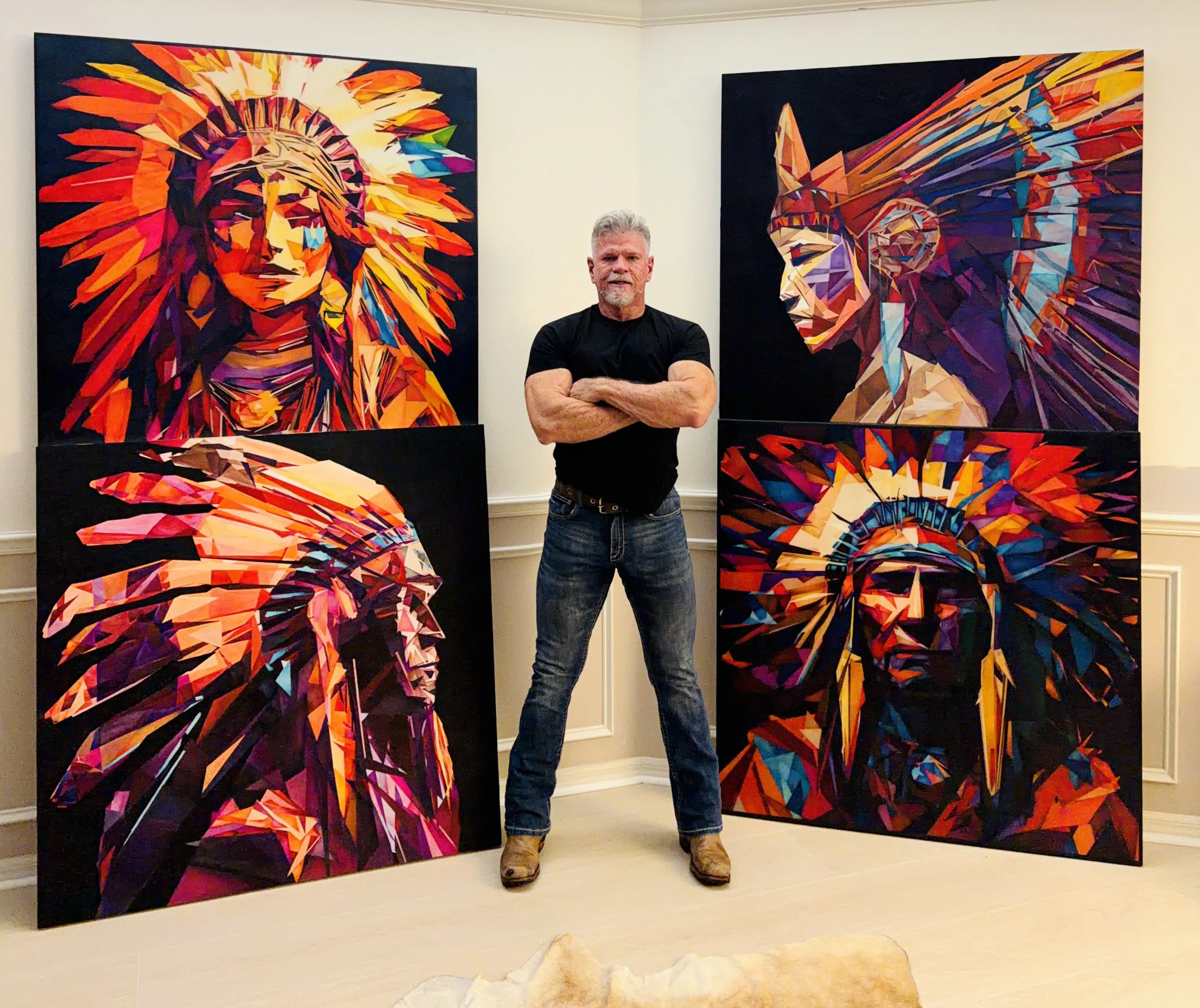
THE QUANTIST COWBOY
David Alderman is a board-certified electroneurodiagnostics technologist, an artist, and a former neuroscience student. His career spans five decades, from traditional painting to finance and technology, then back to the studio in the Colorado mountains. He develops and paints under the Quantism framework, an original synthesis of physics, biology, and neuroaesthetics. His collectors include private clients who commission works for their homes and describe the experience as transformative rather than decorative. Alderman works independently by design: a position he built after COVID-19 closed the doors of his Denver studio and forced him to decide never again to let his ability to work be controlled by someone else.
Leonardo wrote:
“The art of painting is to take a flat surface and, by embracing the forms with chiaroscuro, make it rise to another plane without increasing its volume. A great painting presents itself to the viewer as a complete statement. Its two-dimensional reality encourages a design system that controls the visual surface. This is the geometry of art. All the elements are connected to the external edges of the work by sympathetic lines or colors.”
"Quantism" — A Painting Framework Rooted in Physics and Biology, Not Metaphor
A painter board-certified in electroneurodiagnostics unifies the amplituhedron, morphospace, and neuroaesthetics into one idea. A painting is an interface your nervous system reads before your mind forms a word.
TAMPA / FLORIDA. September 28, 2026. David Alderman is formally naming the framework behind his work, which collectors have long described as producing something other than pleasure: Quantism.
Quantism holds that geometry is not a language humans invented to describe reality, but the structure that reality is made of. In Alderman's framework, a painting is not a representation and not a decoration. It is a geometric interface that encodes a physical response in the viewer, the same way geometry encodes particle interactions in physics and anatomical form in biology.
"This is not metaphor," Alderman said. "It's a mechanism."
Alderman arrives at the claim from an unusual origin. He began painting in 1974, left the art world to study neuroscience, then spent years building businesses in finance and technology before returning to the studio. The result was a working method that lets him describe, in the language of physics and biology, what collectors were already reporting to him in plain words.
Today that report is consistent. Collectors tell him they don't just look at the paintings. They sit with them. They remember things. Some describe hearing a voice they haven't heard in years — their own memory, unlocked by a surface doing nothing but being there. One man, Alderman recalls, sat in front of a work and came back describing his late best friends voice.
"That's not decoration," Alderman said. "That's access to the subconscious."
The argument, in four moves
Quantism is built on a specific set of references, each of which Alderman is careful to cite at its true strength.
Pythagoras first argued that reality is made of number and proportion, not merely described by them — that the same ratios order musical harmony and the motion of the heavens.
The amplituhedron, introduced by Nima Arkani-Hamed and Jaroslav Trnka in 2013, demonstrates that particle scattering amplitudes can be encoded in the volume of a pure geometric object, with space-time and locality emerging as consequences of shape rather than being imposed. Alderman reads this not as a solution to quantum gravity, but as proof of principle: geometry can carry physical information.
Michael Levin's work on morphogenesis shows cells navigating a space of possible anatomical forms — what Levin calls morphospace — steering toward target states by bioelectric signaling rather than executing a fixed genetic script. Form, in this view, is a destination arrived at, not a blueprint printed out.
Neuroaesthetics, from Your Brain on Art to the study of the brain's default mode network, emodied cognition and increased Frontal Lobe blood mflow offers the receiving side: the reported physiological and emotional effects of encountering and making art.
Quantism generalizes these into one principle: there are shapes, and there are interfaces that let a nervous system or a cell register them. A Quantist painting is such an interface.
Why now
Alderman is direct about the urgency. He describes a public being "bombarded by stimulated activity all day long" — a steady, engineered dopamine current he argues is quietly atrophying the right hemisphere, the half of the brain that experiences awe and assigns meaning.
Art, he points out, is older than language. Before alphabets, humans made symbols. It was the first interface between a mind and the idea that the world is more than survival.
"We've kept the frame," Alderman said, "and thrown away the function."
Quantism is his answer to both problems at once: a way to explain why real work has always done something to us, and a reason to put ourselves in front of it again.
The work
Alderman's paintings are geometric compositions built to specific harmonic ratios and proportions — the same mathematics the framework argues does real work on the nervous system rather than decorating it. He describes the surface as analogous to the amplituhedron's volume: a structure whose geometry holds the outcome, read by the body before the conscious mind arrives.
He is adamant about one boundary. Quantism is not mysticism. Every mechanism claim carries a source, every lived account carries the word "felt" or "reported," and no citation is stretched past what it established.
"I'm not asking anyone to believe anything," Alderman said. "I'm telling them to sit in front of something real and feel it themselves." Then I'll hand them the papers."
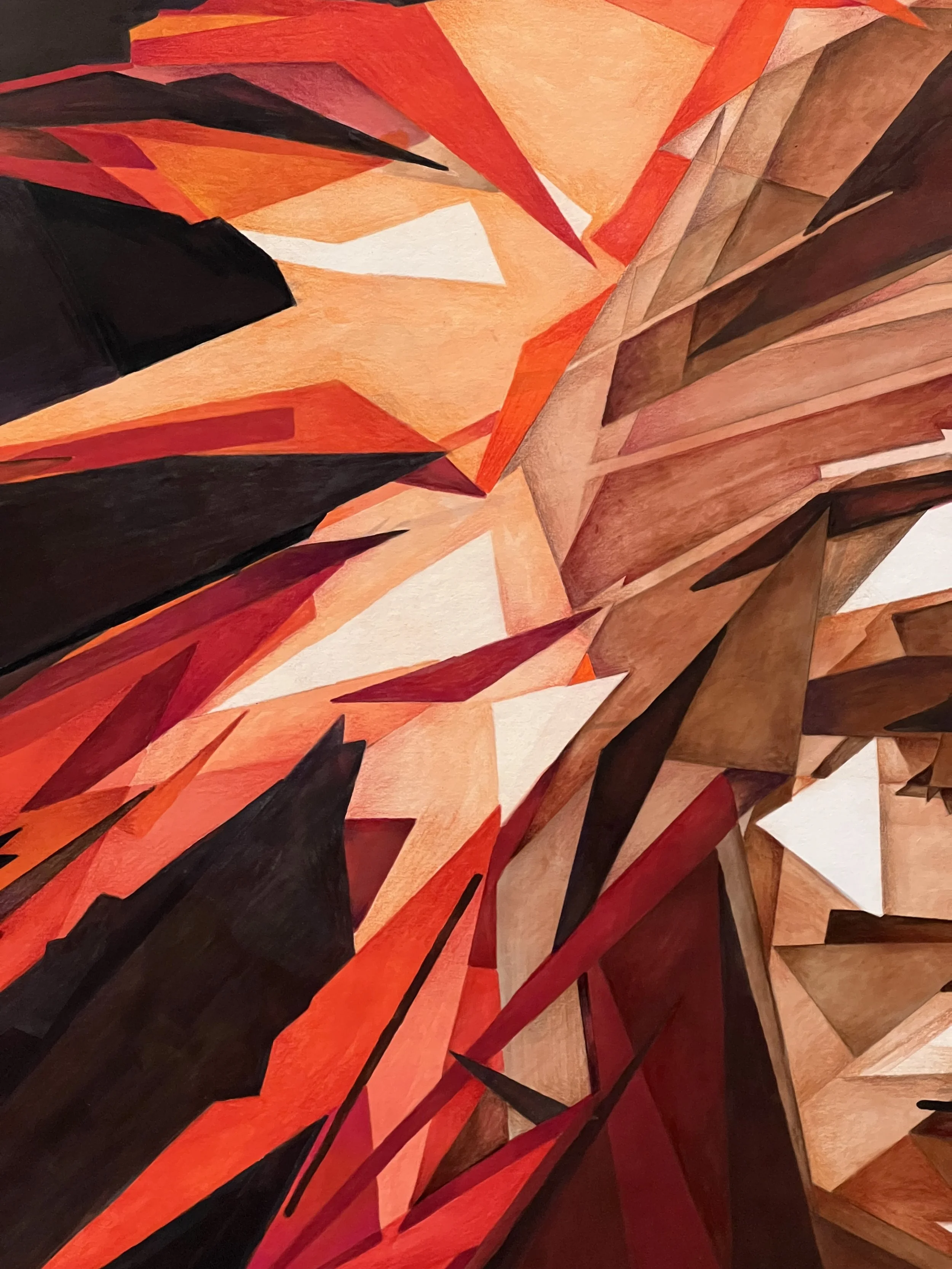
Artist Statement — Quantism
I paint the form the brain already knows how to find.
Semir Zeki's neuroimaging showed that a mathematician moved by an equation and a viewer moved by a painting fire the same brain region: the medial orbitofrontal cortex, the brain's reward hub. Beauty, whether abstract or visual, is paid out in one currency.
But the activation only arrives when you can resolve what you're seeing. It scales with the structure you understand, not structure you merely observe. Beauty is the feeling of your own mind resolving the thing in front of you.
That is why I work with the triangle. It is the minimal unit of constancy. It is the invariant the visual cortex evolved to hunt for, under any light and any angle. It resolves the instant it is seen, before doubt has time to arrive.
Quantism is my name for this. It is not abstraction for its own sake. It is art built on the brain's native search for the invariant. Each work gives the viewer a form their own cortex already knows how to complete. This shortens the path from retina to reward to almost nothing.
Resolution is the reward. Wonder is resolution landing.