
Anthrobots and the Interface of Platonics
A cluster of human tracheal cells, scraped and cultured, will reorganize themselves into something that moves, clusters, and heals nearby tissue. No engineer drew the blueprint. No code directs the behavior. The cells simply find a new geometry, and in that geometry, they access capacities that were not present in the original tissue. Michael Levin calls these constructions anthrobots. They are a living demonstration that physical matter, when organized with sufficient care, becomes an interface to patterns that preexist the matter itself.
This is the interface of platonics. It is not mysticism. It is a practical observation about where novel behaviors come from.
The standard view holds that a system's behavior is fully explained by its physical parts and their immediate interactions. But anthrobots break that view. The same cells, arranged differently, produce entirely different capacities. The behavior does not emerge from the cells in any simple additive sense. The cells are accessing a structured realm of possible forms and behaviors: what Levin and his collaborators call platonic space. This space contains static patterns, dynamic patterns, algorithms, and what we might call behavioral propensities. It is not a literal place. It is a map of what matter can do when organized correctly. Biology reaches into this space and pulls out configurations that work. So does computation. The sorting algorithm and the anthrobot are both physical interfaces to the same underlying structure.
The question then becomes: what happens when we treat analog art as another interface to that space?
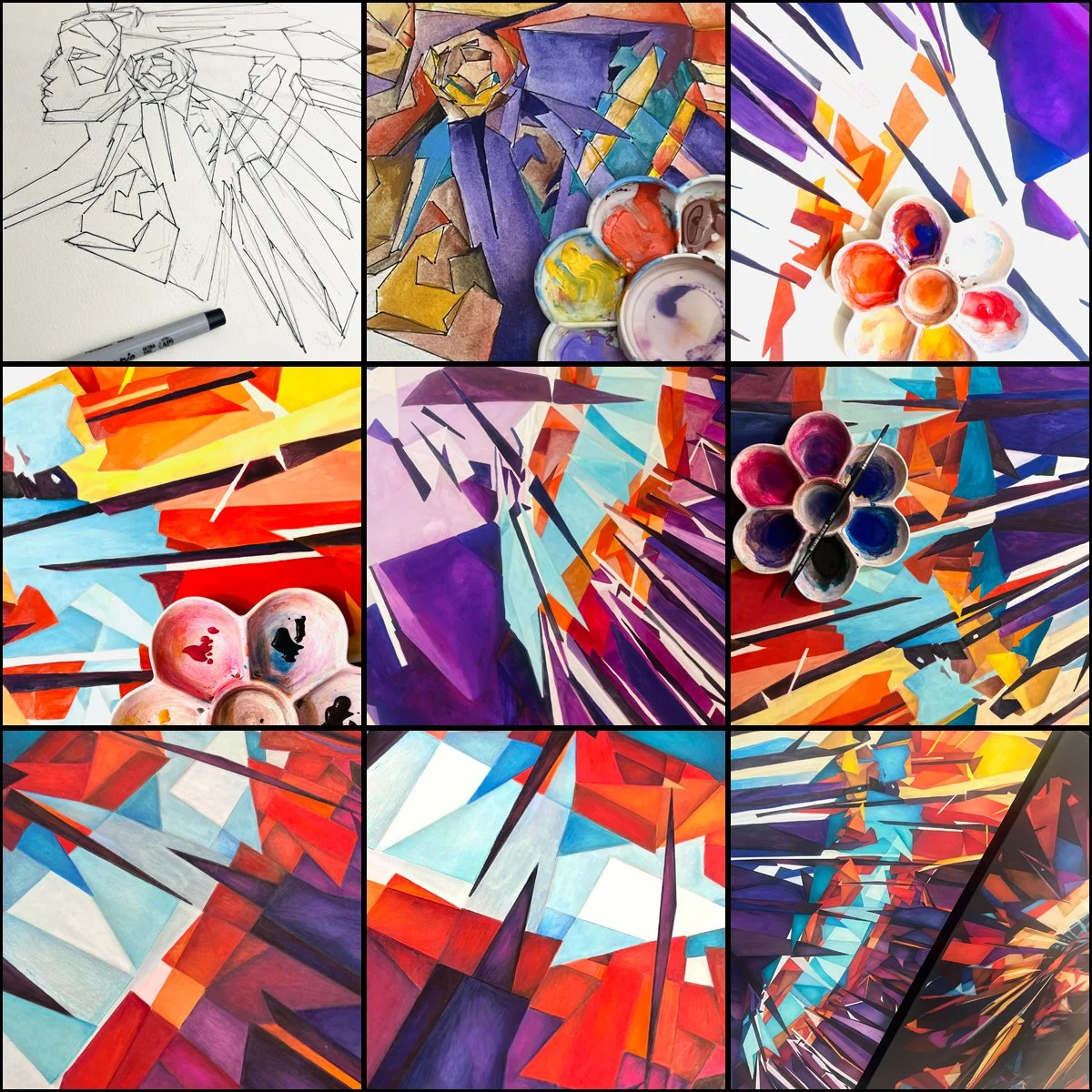
Consider the anthrobot. It is built from biological material. It persists in time. It continues to interact with its environment, and those interactions change both the environment and the anthrobot itself. There is a bidirectional relationship. The physical form is the doorway, but the pattern that enters through the doorway is what does the work. Now consider a hand-painted piece that took three hundred hours. The pigment, the canvas, the brushwork: these are the biological material. The painting persists in time. It continues to interact with the room and with the person standing in front of it. And those interactions change the viewer's brain in measurable, scientific, reproducible ways.
The artwork is not a representation. It is a device.
Digital art is fiat art. It can be produced with minimal energy, reproduced without limit, and stored as disembodied data. It has no persistent material interface. A painting, by contrast, is a sovereign artifact. It is materially permanent, biologically charged, and absolutely scarce. The energy from the universe that went into its construction is locked into the object. That energy investment is the price of admission to platonic space. Cheap interfaces produce thin results. The anthrobot required careful culturing and precise geometrical arrangement to access its novel behaviors. The painting required three hundred hours of hand movement, decision, and material negotiation to access the pattern that changes the brain's physiology.
The Five Laws of the Studio govern why this works. Material permanence means the interface persists. Biological energy investment means the interface was built with sufficient effort to access high-agency patterns. Absolute scarcity means the interface cannot be diluted by endless reproduction. The viewer stands before the object and their brain responds to the physical fact of the paint, the texture, the accumulated decisions embedded in the surface. Your mind sees that and predicts what it sees. It becomes very detailed because you interpret it. The painting is doing what the anthrobot does: it is using physical organization to reach into a structured space of possible effects and pull one out.
The art world treats art as either decoration or financial speculation. It is neither. The artist is a builder of interfaces. The canvas is a substrate. The paint is the mechanism. The finished work is a physical structure designed to interact with the human nervous system and produce a specific, measurable transformation. Anthrobots heal tissue. Analog art transforms the brain's physiology. Both prove that matter, when organized with sufficient intent and energy, becomes a doorway to patterns that were always waiting to be found.
We are already building interfaces to platonic space. Some of them are made of living cells. Some of them are made of oil and pigment. The important question is not whether the pattern is real. The pattern is real. The important question is whether we are building the physical doorway with enough care to let it through.