
THE LISTENER
The Lesson of Silence
PUBLIC COLLECTION RELEASE NOVEMBER 15 2026
The answer is already there
The answer is not new information.
It's what your own knowledge sounds like when nothing is talking over it.
You already hold everything you need to reach one. You've just been standing on top of it, shouting.




The Face That Meets You Head-On
Look at the painting, and it is already looking back.
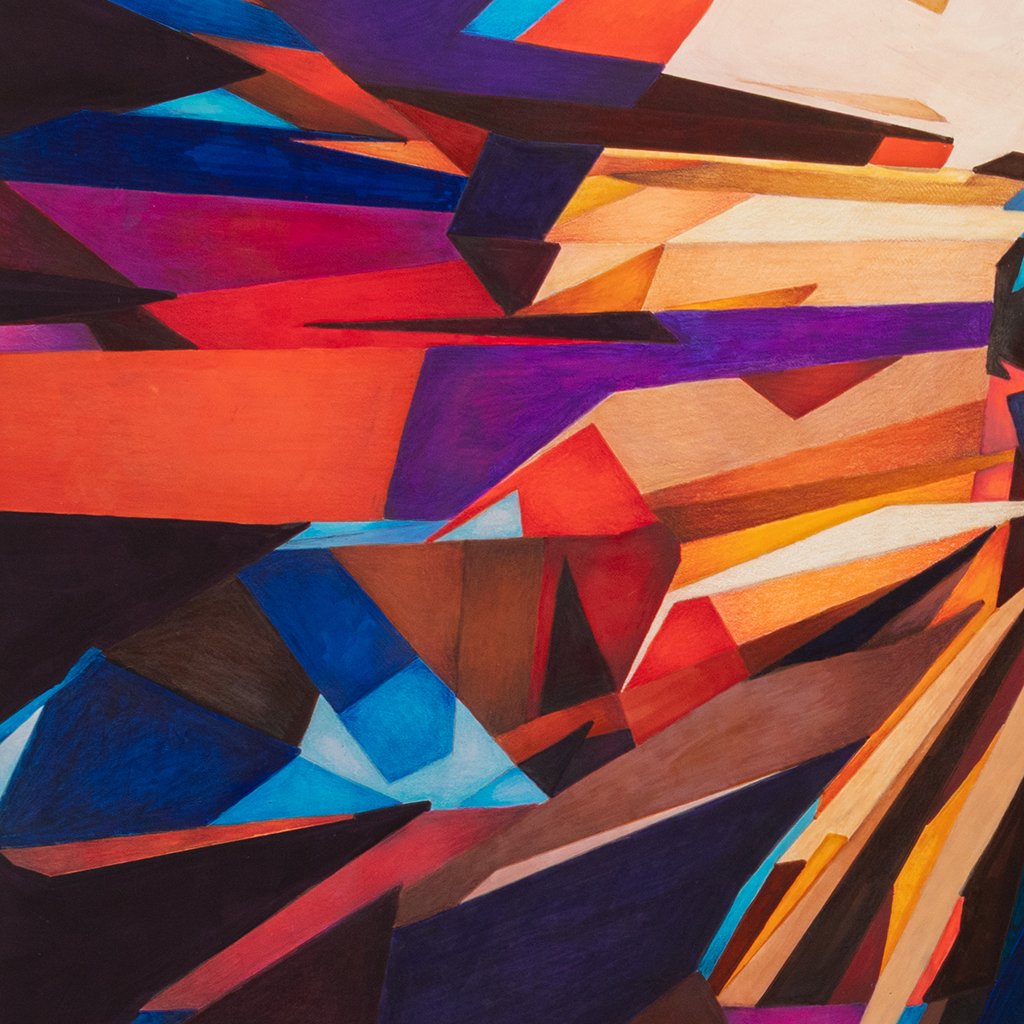
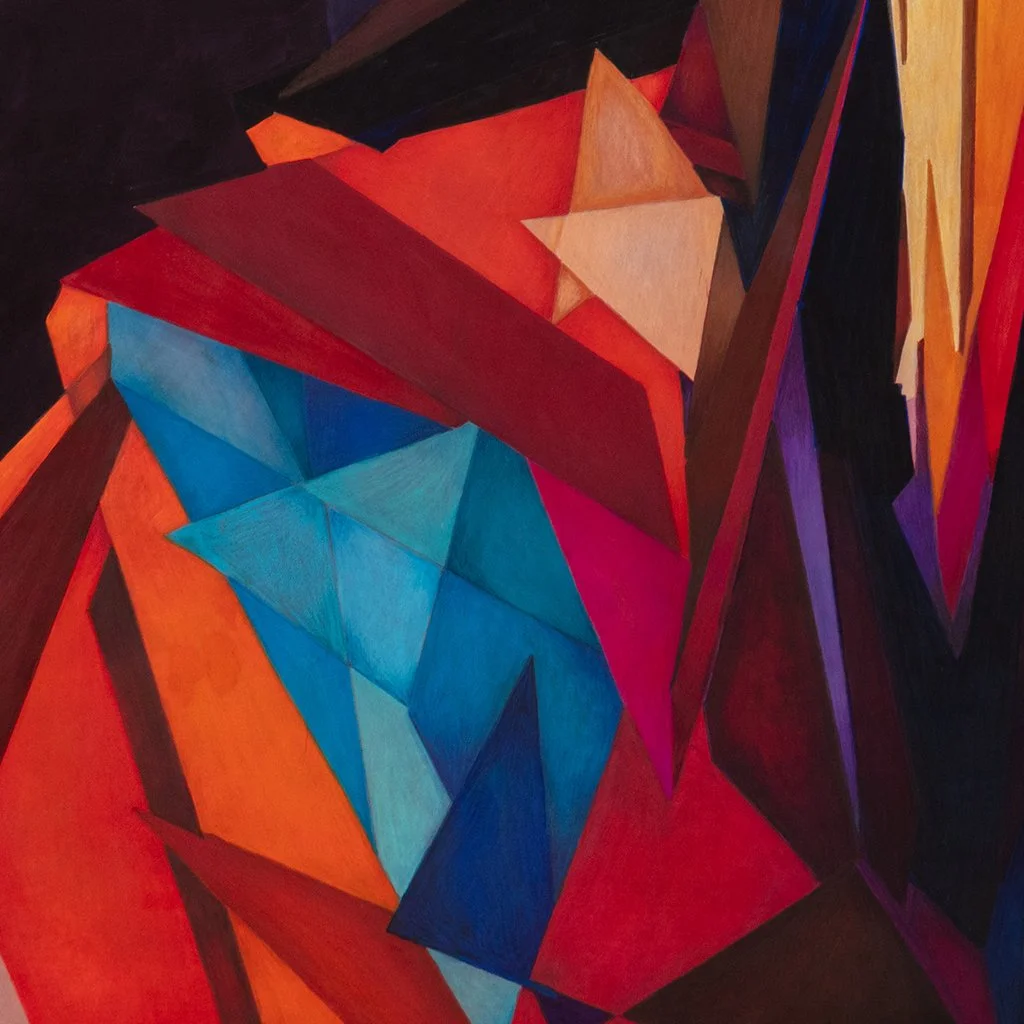
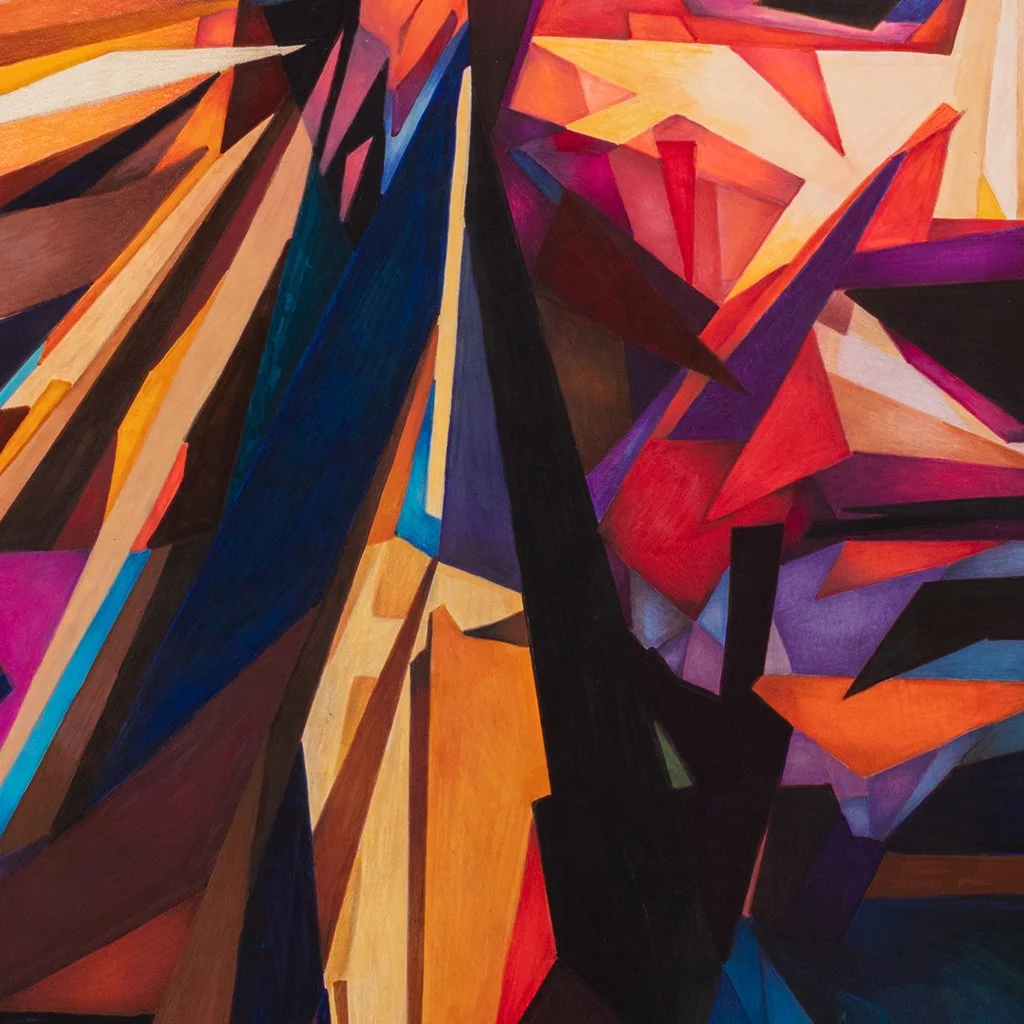
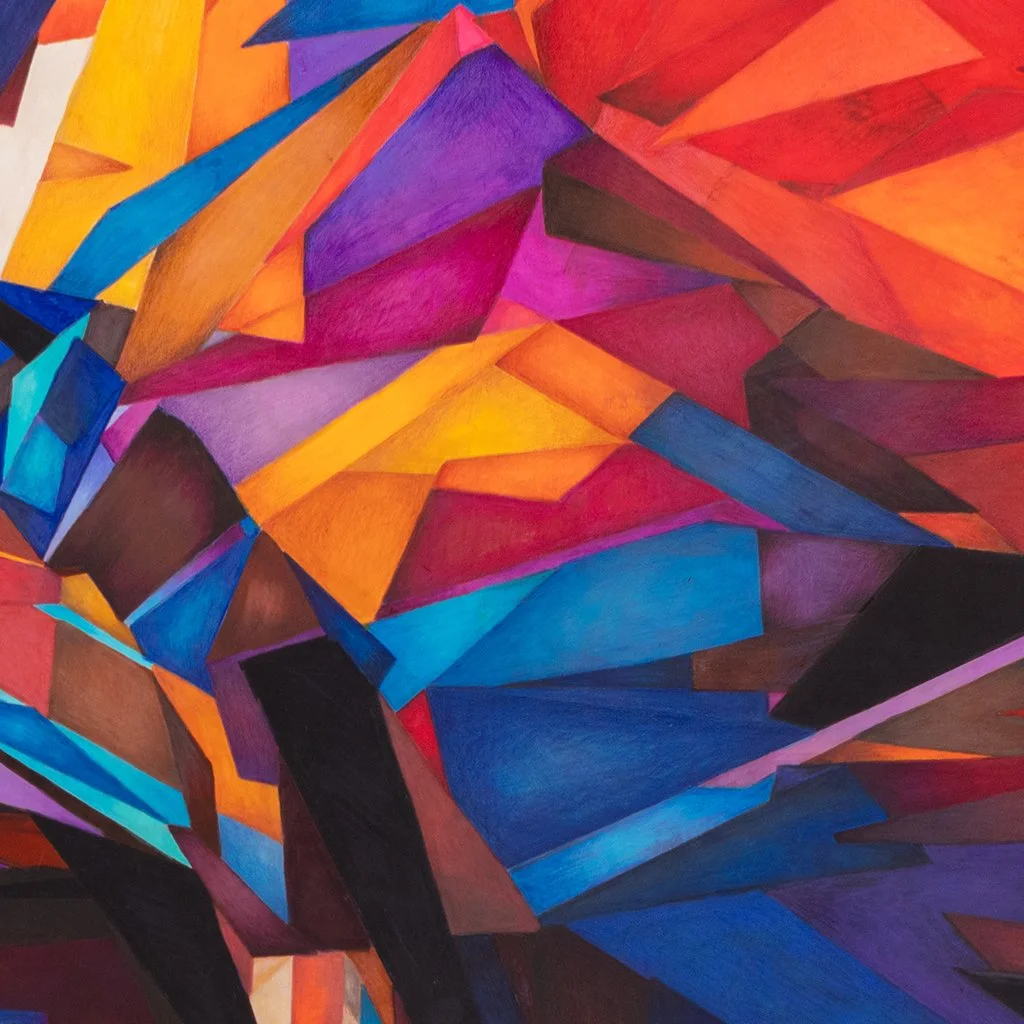
This is the only one of the four that meets your eyes directly, and that was a decision, not a default. Wind shows you a profile because a person being tested has no attention to spare for an audience. The Listener looks straight at you because, by the time you look at it, the work is already done. Nothing is being argued here. Nothing is being chased. You are looking at a face with nothing left to defend.
The headdress opens wide around it. Reds, blues, golds, white light. It is the boldest of the four in color, and this is the part people misread. A frontal face blazing with color reads like a proclamation. It is the opposite. What you are seeing is a mind after it has gone quiet. The canvas is loud because the discipline it records is silent.
Nobody claps for this pillar. It produces nothing visible. You cannot post it. It happens alone, in a room with no witness, in the choice to stop talking.
The Ego Cannot Think Its Way Out
If Wind wakes you up, do this with the waking.
Wind gave you something you did not have before. Not toughness. Confidence, of the real kind: the settled knowledge that something in you survives the weather. That is not a mood, and you don't talk yourself into it. It is what is left after you have been through enough to stop needing the weather to hold still.
Now a problem arrives. And here is the oldest mistake a person makes.
The moment you fear, the ego takes over, and it has exactly one method. It thinks. It believes a solution is sitting somewhere in the future and that enough mental effort will produce it. So it starts running. It rehearses the conversation it will never have. It builds the catastrophe in detail, then lives inside it. It goes around the same loop for the tenth time, then the hundredth, and each pass adds nothing and takes something.
The ego will never tell you it has failed. That is its genius. It reports the spinning as work. It reports vigilance as virtue, and it reports the exhaustion as proof that you are taking the problem seriously. So you keep going, because stopping feels like giving up.
The problem was never a lack of information. You already know everything you need to know. You have the facts, the history, the memory of how this went last time. The spinning is not adding to that store. It is talking over it.
And almost nothing the ego does in that state is actually about the problem. It is about controlling the feeling. Fear has an energy that wants to move, and thinking is the only outlet the mind has, so it runs. That is why you can spend three hours in mental rehearsal and end up less prepared than when you started.
What Fear Costs The Body
Here the teaching stops being philosophy, because it is measurable.
Fear has a body, and the body doesn't ask first. The brain reads a threat, the amygdala fires, the sympathetic branch takes the wheel, and the adrenal glands pour adrenaline into the blood. Heart rate climbs. Breathing becomes shallow and rises into the chest. Digestion shuts down because digesting lunch is not a priority when something might eat you. The vessels in the hands, feet, and skin constrict, which is why fear makes them cold, while blood is pulled away from them and pushed into the large muscles in the legs and trunk.
The system runs an old program written for open country and real predators, and it assumes one thing: you are about to run. It funds the parts that run and defunds the parts that do not. Muscle gets the supply. The gut, skin, immune surveillance, repair work, and the long, slow housekeeping of a body at rest all go on hold.
The mind goes with it. Under sympathetic load, the prefrontal cortex, the part that does your reasoning, planning, and patience, takes a measurable back seat while faster, older circuitry drives. This is why a frightened person makes narrow decisions, repeats themselves, and cannot reach what they know. Not stupidity. Resource allocation, designed for an emergency you can outrun.
Here is the honest problem. Almost nothing that frightens a modern person can be outrun. A diagnosis does not chase you. A layoff does not chase you. A decision you have to make does not chase you. The response fires anyway because the body reads threat the way it always has, and it stays on because the threat never resolves itself.
And the ego's contribution is to keep the alarm ringing. Every pass through the loop runs the threat again. You are not being chased, so you chase yourself. That is the part nobody tells you: the suffering in most hard seasons isn't the event; it is the hours of re-running it with your own mind as the engine.
Run that for years instead of seconds, and it stops being an event and becomes a condition. Sleep degrades. Digestion stays compromised. Blood pressure climbs. The immune system gets sloppy in both directions. Repair work is never scheduled, because the body never receives the signal that the emergency is over. A nervous system that cannot return to baseline is a body quietly shutting down its own maintenance while it waits for a threat that never leaves.
So when this pillar says be still, it is not asking for a mood. It is asking you to stop running a program that is expensive, mismatched to your life, and unfinished.
Stillness Is The Intervention
Now the teaching, older than every discipline built on it.
In a world of constant reaction, real power lies in receptive stillness. The traditions behind these paintings did not treat silence as an absence. They treated it as a place where something arrives.
Be still. Not passive, and not defeated. Still like water, so you can see what is down there.
When you sit in stillness, the noise doesn't resolve your problem, and it never would. What happens is subtler. You stop adding to it. The fear still has its energy, and you are no longer handing it your mind as an outlet. When the mind stops being the engine of the alarm, what's underneath becomes audible.
That is where the answers come from, and they always do. Not because the universe owes you a solution. Because you already hold everything you need to reach it, and you have been standing on top of it, shouting. The answer is not new information. It is what your own knowledge sounds like when nothing is talking over it.
This is not mysticism, and it is not a technique you perform correctly. It is subtraction. Stop feeding the loop, and the loop runs down.
Notice what stillness is not. It is not the absence of fear. Fear will come, and it should, because fear is information, and a person who feels none in a real situation is a danger to themselves. Stillness is not pretending the problem away. It is refusing to let fear spend your body and your judgment.
And notice what confidence has to do with it. This is what the Wind lesson was for. You cannot sit still in a hard moment unless you believe, below the level of argument, that you will still be standing afterward. That belief is not optimism. It is memory. You have been through weather. You have watched the night end before. Stillness is only available to someone who has already learned they survive things.
A frightened person cannot be still, because stillness feels like death. A person with roots can be still because they know the storm passes over something that does not move.
How Stillness Arrives
The body will not take an order to calm down, and this is where willpower fails, and almost everybody gets stuck.
Stop trying to think your way into stillness. That is the ego attempting the same trick under a new name, and it didn’t work. Calm is a physiological event, and the body has a direct line to it. The line is breath.
Breath is the one autonomic process you can manually control, and controlling it changes state. Slow the breathing, especially the exhale, and vagal afferents carry that signal from the lungs and the heart up through the brainstem to the prefrontal cortex. Vagal tone rises. Heart rate variability rises with it. Breathing at roughly six breaths a minute, about five or six seconds in and five or six seconds out, is the widely studied sweet spot, and it shows measurable shifts in autonomic state and in the connectivity between the prefrontal cortex and the insula. You are breathing yourself into a different processing mode.
The effect on the mind matters here. With higher vagal tone, the prefrontal cortex engages more, and the alarm circuitry quiets, so reasoning and patience come back online. The frightened person making narrow choices is not a fixed fact about them. It's a state, and you can change it from the inside with a breath cycle practiced until it is available under pressure.
That is why stillness is a skill and not a decision. You do not learn it in the middle of the storm, for the same reason you don’t learn to sail in one. You practice on ordinary days until it is yours, and then it comes with you. And the answers, arriving later, have a nervous system available to receive them.
Why The Painting Does This
The last piece is the surface itself, and here the art stops being decoration and becomes equipment.
A field called neuroaesthetics has a simple finding: viewing art engages the visual system, the brain's reward circuitry, and the default mode network at the same time. The default mode network is the set of regions that come online when a person turns inward, connecting what they see to memory, self, and meaning. It is the system that does exactly the work this pillar is about. And it doesn't engage equally with everything. Work a viewer finds genuinely moving pulls the network into contact with the act of looking. Work that does not gets a shallow response, and the mind drifts away.
That's why these surfaces are built the way they are. A hand-made painting carries microtexture, variation in pigment, evidence of a real object made by attention over a long period, and the nervous system reads that physical history before the mind has a word for it. This has a name too: embodied cognition, the fact that the body participates in thinking rather than receiving a report from it. You don't look at The Listener and then decide stillness is a discipline. Your posture goes quiet first.
Put the two halves together, and the mechanism of this pillar falls out. A person in fear mode is running a narrowed, fast, closed program with the frontal equipment partly offline, and cannot register a lesson about stillness, because open attention is exactly what the program has shut down. A person in a calm, engaged, embodied state is doing the opposite. The default mode network is active, connecting what they see to what they know. That is the state in which meaning lands.
So the painting is not a picture of someone sitting quietly. It is a way of getting the viewer's body into the state the lesson requires before the lesson is read. The white light at the center, the wide opening headdress, the face that refuses to reach for anything. None of it is meant to be understood. It is meant to be registered, and the body registers it, the same instrument the silence runs on.
The Lesson in a Life
He had a decision to make and no way to make it.
That was all; it need not be dramatic to be unbearable. Two options, both survivable, neither clean, and no further information coming. He had done everything a competent person does. He had made the list. He had talked to the people who knew the situation. He had asked the ones who had been through it. He had the facts, and they wouldn't change no matter how many times he rearranged them.
So he kept rearranging them. That is the part he is honest about now, and he tells it without flattering himself. He would wake at four in the morning and run the entire thing from the top, both branches, all the way to the end, and then run it again. He was not deciding. He was re-deciding, dozens of times a day, and each pass cost him something.
His body kept the score. His stomach was a problem for most of that year. His sleep broke and never fully came back. His shoulders sat up by his ears, and he developed a habit of noticing it and doing nothing about it, which is its own kind of confession. He was tired in a way sleep didn't touch, because the spinning didn’t stop when you lay down.
He talked about it constantly. To his wife, to a friend, to anyone who would take the problem off him for an hour, and every conversation felt productive and changed nothing. He had mistaken motion for progress, which is the ego's oldest trick. By the end, he couldn't have told you what he was afraid of, because the original fear had long since been buried under the fear of not being able to solve it.
Nothing he did changed it.
He was driving, alone, on a road he had driven a thousand times, and somewhere in the middle of running the loop again he simply stopped. Not by decision. He had run out. The mind had no more passes in it, and for about ten minutes there was nothing in the car but the road and the radio and no thinking at all.
In that quiet, the thing he actually wanted became obvious. Not the optimized answer, not the one that held up best under argument. The thing he wanted, which he had known the entire time and had been unable to hear because he would not stop talking over it.
He took the option that didn’t win on paper. He has never once been able to argue it into a spreadsheet, and it was right.
That is the pillar, and it is smaller than it sounds. He did not find the answer in stillness. He stopped the noise, and the answer that had been standing there the whole time became audible. That means his thinking never solved it. His thinking was what was hiding it.
The Lesson
Wind gives you the root. This pillar is what the root is for. Sit down, be quiet, and let the answer come, because it will. It always does.
The lesson, all of it, in five lines:
The ego cannot think its way out. When you're afraid, the mind believes more effort will produce the answer. It reports the spinning as work. Nothing in the loop is new, and every pass costs you something.
The suffering is usually the re-running. Not the event. The hours of running the event again with your own mind as the engine. You can't outrun almost anything that frightens you, so the alarm never gets told to stop.
The body keeps the score. Sleep, digestion, blood pressure, repair work, patience, judgment. A nervous system that never returns to baseline quietly shuts down its own maintenance. Be still, and the body starts the work it has been waiting to do.
Stillness is subtraction, not effort. Stop feeding the loop, and the loop runs down. Fear will still be there, and that is fine. It is information, and you do not have to obey it.
The answers come. You already hold what you need. Stillness does not give you new information; it stops you from talking over what you know. Wind taught you the confidence to sit still: something in you survives the weather.
The lesson stands there looking straight back at you, waiting to be noticed.