
REBORN
The Lesson of Becoming
PUBLIC COLLECTION RELEASE NOVEMBER 15 2026
The palette went the other way
Suffering is the easiest thing in the world to paint, and the easiest thing to believe.
That's why the choice took the longest. This canvas could have been darkness. It would have been easy, and people would have praised it.
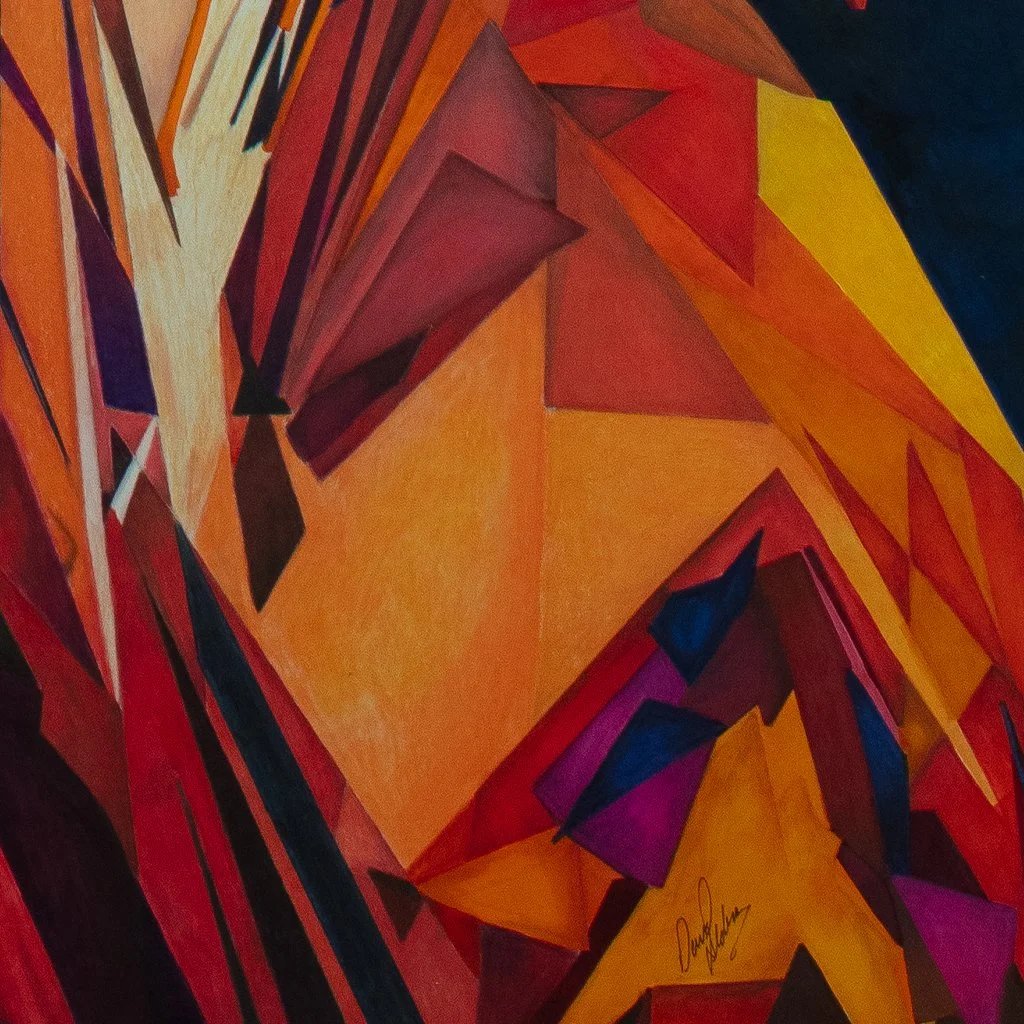
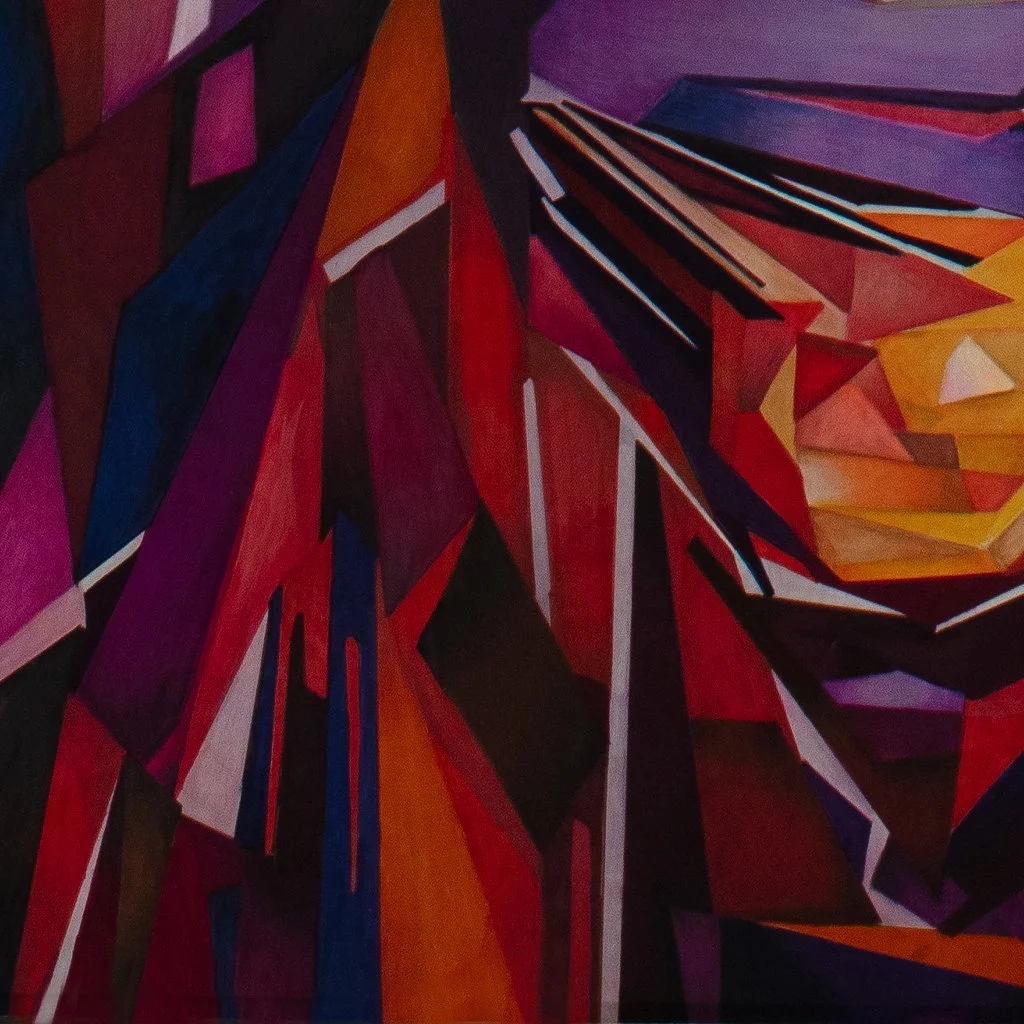
The palette goes the other way on purpose: red, gold, yellow, burnt open behind the head. The calm of a fire that has found its shape.
Not the chaos of a thing being destroyed. The birth of a thing being made..






The Face That Was Not Born
Look at the painting, and the first thing you notice is what is missing. There is no wound in it. No ash, no ruin, no figure on its knees.
That's what people expect, and it is not what is here. What is here is a full halo of red, gold, and yellow, burnt open behind the head, the widest color field in the collection, and a face sitting inside it, calm the way a fire is calm once it has found its shape. Not the chaos of a thing being destroyed. The heat of a thing being made.
This is the brightest canvas of the four, and that was the decision that took the longest. Reborn is the only pillar that could have been painted as darkness. It would have been easy. Suffering is the easiest thing in the world to paint, and the easiest thing to believe. Instead, the palette goes the other way, because the pillar is not about what the fire takes. It is about what comes out the other side, and what comes out is not a survivor with their jaw set. It is someone rearranged and not sorry.
Look at the geometry, and you can see where it came from. The planes are cut from the same vocabulary as Wind's, the same amplituhedron fractals, the same hard edges and no blending. But the pressure has changed direction. In Wind, the planes tear sideways off the skull because the force comes from outside, and there is nothing to do but yield. Here the geometry opens outward from the center of the face in every direction at once. Nothing is being pushed. Something is being released.
Same cuts, different energy. That is what a person looks like when they have stopped being the thing that happened to them.
Two Lessons, One Engine
This pillar adds no third teaching. It is what the first two were for.
Wind gives you the root: the part of you the weather cannot reach, and the memory that you have been through weather before and the morning still came. The Listener gives you the quiet: the practice of stopping the noise so you can finally hear what you already know.
Put those together, and you have everything you need to change who you are, a claim people make casually and almost never mean. Here is what it actually asks.
When life closes in, and you can't see an exit, the instinct is to think your way out. That is the ego running the loop from the second pillar, and in a small problem it wastes a week. In a real shattering, it does something worse. It takes the identity that has just been broken and tries to reassemble that exact identity from the pieces, because that is the only self the ego knows how to defend. It endlessly rebuilds on a foundation that cannot hold, because the foundation it is rebuilding on is gone.
The way out is the other direction. Stop the noise, which is The Listener. Hold the confidence that the storm ends and that you are under it, which is Wind. In that stillness, what is actually yours becomes audible: not the identity built around the job, the marriage, the body, the role, the person, but the one underneath, never constructed from those materials in the first place.
That is the rebirth. Not a new costume over the same self. A rearrangement of what was already there, released the moment you stop trying to restore the old shape.
And notice it is a joy and not a surrender. That is the part we miss, because we are trained to think transformation has to hurt to count. Once you set down the old identity, what is left isn’t an empty person. It is a person with their equipment back.
What Actually Changes
Here, the pillar stops being a metaphor because the change is physiological and measurable.
The self you carry around is not a fixed object. It is a set of predictions. The brain is a model builder, constantly assembling a working theory of who you are, what you are good at, what is safe, and what will happen next, and then using that theory to interpret everything that arrives. Identity is that model at scale. It runs faster than thought, which is why it feels less like a belief and more like a fact about the world.
A shattering breaks the model, not the person. The event did not take your self away. It invalidated a large section of the map, and the pain largely comes from reading the map against a world that no longer matches it.
Here is the useful part. Because the model is assembled rather than given, you can reassemble it. This is what neuroscience calls self-directed neuroplasticity: the adult brain retains the capacity to rewire itself in response to directed attention, and the rewiring depends on activity. Whatever you practice, in attention, becomes structure. What you rehearse is what gets built, physically, in the tissue.
That is why the two lessons are not optional. Change of this kind requires the nervous system to be in a state where new structure can form, and a body in fear mode is a body running the sprint protocol: prefrontal equipment partly offline, digestion shut down, repair work postponed, everything narrow and fast and closed. Nothing gets rebuilt in that state because the system believes it is in an emergency, and emergencies are for running, not remodeling.
The Listener's silence is what gets you out of the emergency. The physical practice is the same one described in that pillar: slow the breath, especially the exhale, to roughly six breaths a minute; vagal tone rises with it, the prefrontal cortex comes back online, and the alarm quiets. And Wind's confidence is what lets you stay there. You cannot sit still in a hard moment unless something in you believes you will still be standing afterward, and that belief is not optimism. It is memory, and memory is what the first pillar built.
So the mechanism of this pillar, in order: you stop the loop, the nervous system returns to a state where it can build, and then attention does the work. Not attention on the wound. Attention on what you are becoming. You rehearse the new self the way you rehearsed the breath, in small amounts, on ordinary days, until it is structure rather than intention.
That is transmutation, and it is not a poetic word for time passing. Time passes for everyone. The fire only makes something when it is attended to.
Where The Power Comes From
Every tradition that has lasted has had this passage, and they all surrounded it with ceremony. That is not decoration and it is not superstition. It is engineering, and it worked for the same reason the two lessons work.
A person in the wreckage needs two things from the people around them. The first is an expectation: that they will come out the other side changed rather than unchanged, and that the cha’t a betrayal of who they were. A person held to an expectation survives differently than someone told to move on. The second is mirroring. Human nervous systems are built to co-regulate, and one settled person can measurably stabilize another's heart rate and stress response. You do not talk someone into a new identity. You sit near them, settled, for long enough that their system learns yours.
This is why the traditions sent people through the fire in company, not alone, and why the two lessons travel. A real root can be leaned on by someone else. A practiced stillness can be taught by proximity. What looks like a personal rebirth is almost always a private event held up by a group who had done it before and were ’t frightened by the passage.
The other honest note: the fire is not a course, and it does not take a season. Whatever this pillar promises, it does not promise speed. Two years is fast for this. It promises that the direction is set, that you will not come out the same person, and that the difference is on your side.
Why The Painting Does This
The last piece is the surface, and here the art stops being decoration and becomes equipment.
A field called neuroaesthetics has a simple finding: viewing art engages the visual system, the brain's reward circuitry, and the default mode network at the same time. The default mode network is the set of regions that come online when a person turns inward, connecting what they see to memory, self, and meaning. It does exactly the work this pillar is about, and not everything engages it equally. Work a viewer finds genuinely moving pulls that network into contact with the act of looking. Work that doesn't gets a shallow response, and the mind drifts away.
That is why these surfaces are built the way they are. A hand-made painting carries microtexture, variation in pigment, and the evidence of a real object made through sustained attention, and the nervous system reads that physical history before the mind has a word for it. This has a name too: embodied cognition, the fact that the body participates in the thinking rather than receiving a report from it.
Now the part specific to this canvas. The opening geometry, the planes radiating outward from the center of the face, the full halo of heat, reads as the body expanding before it is understood as an idea. That is the physical shape of something being released rather than compressed. You don't look at Reborn and conclude that a person can be rearranged. Your posture loosens first, which is the same loosening the lesson is asking for.
Put it together with the science and the mechanism of the pillar falls out. A person in fear mode runs a narrow, fast, closed program with the frontal equipment partly offline and cannot register a lesson about becoming, because the system has decided it is in an emergency. A person in a calm, engaged, embodied state is doing the opposite. The default mode network is active, connecting what they see to what they know, and the frontal regions are available to do something with it. That is the state in which a new self can actually be rehearsed.
So the painting is not a picture of someone who survived. It gets the viewer's body into the state where becoming is possible before the lesson is read.
The Lesson in a Life
It arrived in the second week of September. A Tuesday, and not a dramatic one. Somebody's truck had work done, and they wanted the shop open early, and Ray was three days into a cold thing he had been telling himself was just a cold thing.
Everyone liked him. That is what people say first, and it is meant kindly, and it is also the whole problem.
He was fifty-eight and had spent twenty-two of those years as the guy at the shop you could rely on. Quick with his hands, quicker with a joke, always good for a hand moving a couch or covering a shift. He had no wife, no kids, and a boat he took out alone on Sundays. He built his whole life around being available, and he mistook that for a life. Available to friends. Available on call. Available standing in for somebody else's shift. He said it in one line, and it has stayed with the people who heard him: I never once decided anything. I just showed up.
He was not a victim of anything. That is why it was interesting. Nothing had been done to him. He had simply spent twenty-two years being exactly what everyone else needed, and there was nothing underneath. No plan. No hobby nobody knew about. No opinion about his own life. He was the fifth wheel, and the shop closed.
For most of that first year, he did what the second pillar warns about. He ran it. He replayed the same conversations, recalculated the same money, made list after list of who to call. His body kept score: sleep broke, his stomach a mess, his shoulders hiked up to his ears. He talked about it constantly. Every conversation felt productive and changed nothing, and after a year he had two boxes of unsent applications and no idea who he was supposed to be. He had mistaken motion for progress, which is the ego's oldest trick, and he was honest enough to see it by the end.
What actually changed was smaller than any of that. He stopped. Not the thinking at first, just the talking. He took his own boat out on a Tuesday morning, alone, for the first time on a weekday, and did not bring up the relocation with anyone for the next two months. He did not call the boys, and he didn’t rebuild the list.
In that quiet, what had been underneath it all became audible.
They asked him to move to another city for the same work, and every argument pointed to no. He was going to go anyway because it was the only offer on the table, and he didn't know why. Then, while he was putting the trailer in the water and not thinking about it at all, it surfaced, and it was not complicated. He had wanted to be a father once, and had let that go twenty years ago without ever deciding to. What he actually wanted was not the job. It was the years back, and the thousand small things he had told himself he was too busy for. He wanted to work somewhere small and stay put.
He took the job. But this time, he built the life he actually wanted: he stayed in town, took a smaller position nearby, started doing three shifts a week at a shop two of his old guys had opened, and married his partner of eleven years the spring after. He ran the boat on Sunday mornings and didn't go back to being only the guy you could rely on. He still shows up for people. He made it a choice.
That is the pillar, and the bloom is not dramatic. He did not find a self he had hidden. He stopped the noise long enough to hear what was underneath, and there was an identity there that had never been built on the job at all.
Two lessons, borrowed from the pillars before it. Wind gave him the confidence to sit in it. The Listener gave him the quiet. The rest was the life he had never gotten around to being.
The Lesson
Wind teaches you that storms end. The Listener teaches you to sit still inside one while it does. Reborn is what those two add up to. Sit down, get quiet, and the person you were underneath the noise comes back within reach. Not the same, not restored. Rearranged.
The lesson, all of it, in five lines:
Nothing has to break first. This is not a reward for suffering, and it doesn’t require a catastrophe. You do not have to earn the right to become someone new. A quiet Tuesday and two practised lessons are enough.
You can set down an identity that no longer fits. The self built on the job, the marriage, the role, the person, the habit of being what everyone else needed, is not a foundation. It is a costume, and you can take it off on purpose.
Stillness is what lets the new self be built. Nothing gets remodelled in a nervous system that thinks it is being chased. Stop the loop, clear the noise, and the thing underneath becomes audible.
Confidence is the fuel. You cannot be still enough to change if something in you is afraid the storm never ends. Wind gives you the root, and the root lets you stand in your own life and choose.
This is a celebration. Rebirth is the bloom, and the bloom is the point. Not what it cost you, but the person standing in the light afterward: changed on purpose, chosen, and not sorry.
The light was always there. Learning to stand in it is the answer.