

Neuroaesthetics the Science
Zeki
In his landmark 2014 study, The Experience of Mathematical Beauty and Its Neural Correlates, Semir Zeki and his team (collaborating with mathematicians including Sir Michael Atiyah) demonstrated that experiencing beauty derived from purely abstract, intellectual formulations activates the exact same emotional brain region as visual and musical art: field A1 of the medial orbitofrontal cortex (mOFC).
This established that human aesthetic appreciation relies on a common neural currency, whether the stimulus is a sensory masterpiece or an austere string of mathematical symbols.
1. The Experimental Design: Measuring Abstract Beauty
Zeki presented 15 mathematicians and non-mathematicians with 60 mathematical formulations while scanning them using functional Magnetic Resonance Imaging (fMRI).
The Formula Spectrum: Subjects viewed formulas spanning analysis, geometry, and number theory. Euler’s identity (e^{i\pi} + 1 = 0) was consistently rated as the most beautiful, celebrated for linking five fundamental constants (e, i, \pi, 1, 0) and three elementary operations in minimal form. Srinivasa Ramanujan’s infinite series for 1/\pi was most frequently classified as aesthetically ugly due to its cumbersome visual density:
Parametric Hemodynamic Scaling: In mathematicians, the blood-oxygen-level-dependent (BOLD) signal in field A1 of the mOFC scaled linearly with the subjective rating of beauty. The greater the felt elegance of the equation, the higher the metabolic activity in the mOFC.
2. Neural Architecture: Visual Art vs. Mathematical Beauty
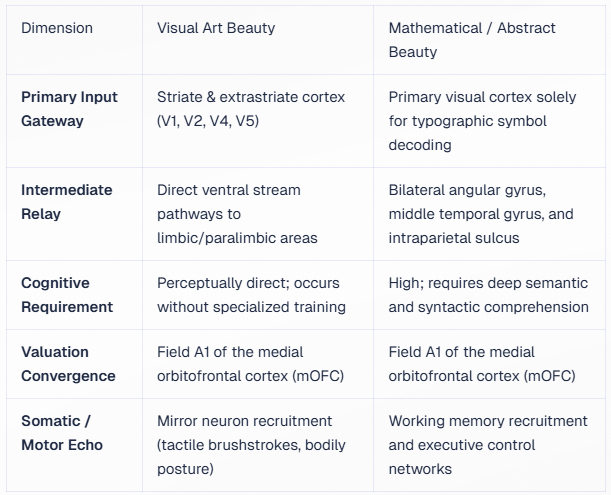
While both forms of beauty converge on the mOFC, the neural pipelines feeding into that hub differ fundamentally:
When viewing a painting, the brain performs sensory-driven feature binding. Visual modularity segregates orientation (V1), color (V4), and motion (V5), passing signals rapidly along the ventral pathway to the amygdala and mOFC. A viewer can register aesthetic pleasure nearly instantaneously without needing a formal semantic lexicon.
The Visual Route
Mathematical symbols carry no innate sensory beauty—the visual marks ("e", "\int", "=") are arbitrary glyphs. The brain must first process them through language and calculation networks:
The angular gyrus and intraparietal sulcus decode mathematical syntax, magnitude, and spatial relationships.
The middle temporal gyrus parses semantic meaning and symbolic reference.
Only after the cognitive architecture resolves the structural economy, symmetry, and universal truth of the equation does it dispatch signals to the mOFC to generate the affective "thrill" of beauty.
The Abstract Route
3. Understanding vs. Aesthetic Experience
One of Zeki's most critical findings was the neurological decoupling of understanding from appreciation:
Comprehension is necessary, but not sufficient, for beauty.
When non-mathematicians viewed equations, their mOFC showed no significant parametric change, even if they found the calligraphic shape of an equation pleasing. Without semantic comprehension, the abstract beauty remained locked.
Conversely, mathematicians fully understood equations that they categorized as ugly or neutral. Cortical regions responsible for calculation and cognitive effort remained active regardless of rating, proving that the mOFC activation is not a byproduct of problem-solving, but an independent evaluation of elegance, economy, and harmony.
4. The Neurobiological Resolution of Platonic Beauty
Zeki’s work directly confronts Plato’s classical doctrine that mathematical truth belongs to an independent, non-physical realm of pure Forms accessible solely by the intellect.
By localizing mathematical appreciation to field A1 of the mOFC, Zeki demonstrated that what mathematicians describe as "Platonic beauty"—the perception of immutable, universal order—relies on the same evolutionary reward machinery that values basic biological imperatives.
The brain's visual cortex evolved to seek constancy (invariants beneath changing lighting and perspectives). Mathematics represents the ultimate extension of this neurological drive: distilling infinite physical chaos into compact, invariant laws. The mOFC's activation is the brain's internal reward signal for detecting maximum structural coherence with minimal cognitive entropy.
Rather than treating ugliness simply as the passive absence of beauty, Semir Zeki and neuroaesthetics researchers discovered that the brain processes ugliness, discord, and dissonance as an active, defensive reaction. The experience is defined by two simultaneous events: a localized withdrawal of activity in reward valuation hubs and an immediate recruitment of the motor cortex and visceral threat networks.
5. The Valuation Axis: A Single Neural Continuum in the mOFC
In early aesthetic philosophy, thinkers debated whether beauty and ugliness were governed by separate faculties or opposite poles of the same axis. Semir Zeki and Tomohiro Ishizu settled this neurobiologically:
Parametric Modulation: There is no dedicated, standalone "ugliness center" in the frontal lobe. Instead, the medial orbitofrontal cortex (mOFC) acts as a bidirectional valuation meter.
The BOLD Signal Gradient: As a viewer transitions from evaluating an artwork as beautiful to indifferent, and finally to ugly, the blood-oxygen-level-dependent (BOLD) response in the mOFC drops in a linear, parametric fashion. Stimuli classified as ugly register the lowest levels of metabolic activity in this region.
Neural Devaluation: The brain registers ugliness first as a metabolic collapse of intrinsic reward, signaling that the object offers no sensory, cognitive, or evolutionary utility.
6. The Somatomotor "Recoil" Response
The most unexpected discovery from Zeki’s imaging experiments (notably Kawabata & Zeki, 2004, and Ishizu & Zeki, 2011) was the behavior of the motor cortex:
While beautiful art induces sustained perceptual contemplation, viewing paintings rated as ugly provokes significant bilateral activation in the motor cortex, premotor cortex, and postcentral gyrus.
Zeki interpreted this as an evolutionary action readiness program:
Ugliness in the ancestral environment—rot, asymmetrical faces indicating disease, venomous markings, or decayed vegetation—signals bio-hazard or threat.
The visual brain links aesthetic repulsion directly to the somatic motor system to prepare the body for physical avoidance, evasive maneuvers, or defensive flight before conscious deliberation takes place.
B. Visceral Aversion: Amygdala and Anterior Insula
Beyond the primary motor strips, aesthetic discord engages subcortical limbic regions that manage defense and disgust:
Left Amygdala Recruitment: In Ishizu and Zeki’s 2011 fMRI paradigms, visual ugliness generated significant activity in the left amygdala. The amygdala functions as a rapid-response vigilance hub; its firing reflects the detection of high-salience negative valence and potential environmental hazards.
The Insular Disgust Circuit: When visual or conceptual art tilts toward the grotesque, abject, or physically distorted, neuroaesthetics literature shows robust activation of the anterior insula. Because the insula processes chemical taste, viscero-sensory distress, and physiological contamination, aesthetic ugliness borrows the identical neural architecture that protects the body against ingesting poison.
C. Acoustic and Sensory Dissonance: Processing Roughness
Research into musical discord (conducted by Anne Blood, Robert Zatorre, and Stefan Koelsch) parallels Zeki's visual findings, demonstrating how the brain handles harmonic clash:
Critical Bandwidth and Acoustic Roughness: When two sound frequencies fall within a single critical bandwidth on the basilar membrane, the auditory system cannot resolve them independently. Rapid amplitude fluctuations (beating) generate sensory roughness, which the cochlea passes as high-frequency neural phase jitter to the primary auditory cortex.
Striatal Deactivation: Dissonant musical intervals (such as the tritone) halt dopamine release in the nucleus accumbens and ventral striatum, while activating the parahippocampal gyrus and retrospenial cortex. The sensory system reads acoustic discord as destabilizing entropy.
D. Prediction Error and Cognitive Friction: Anterior Cingulate Cortex (ACC)
Aesthetic dissonance often stems from a deliberate violation of visual grammar: clashing color temperatures, ruptured perspective, or disrupted symmetry.
According to Zeki's Law of Constancy, the brain expends tremendous energy constructing stable perceptual invariants out of dynamic incoming sensory data. When visual art presents irreconcilable contradictions (e.g., in Dadaism or brutalist surrealism), the brain cannot complete its feature-binding operations.
This cognitive friction activates the dorsal anterior cingulate cortex (dACC):
The dACC identifies the stimulus as a prediction error—a mismatch between internal top-down expectations and incoming bottom-up sensory patterns.
If this tension cannot be resolved into a higher-order concept, the brain flags the unresolved perceptual load as aesthetically jarring and uncomfortable.